
At the Head of the Rapid
I went to the Kemijoki to teach my father how to cast a fly rod. We had two hours before the rain was supposed to return, a box of flies I had tied for him, and a cold north wind moving down the river. By the time we left, his casting had begun to find its rhythm, and I had held my first rainbow trout, 47 centimetres of silver and pink that struck at the head of the rapid while my father filmed the fight from the bank.
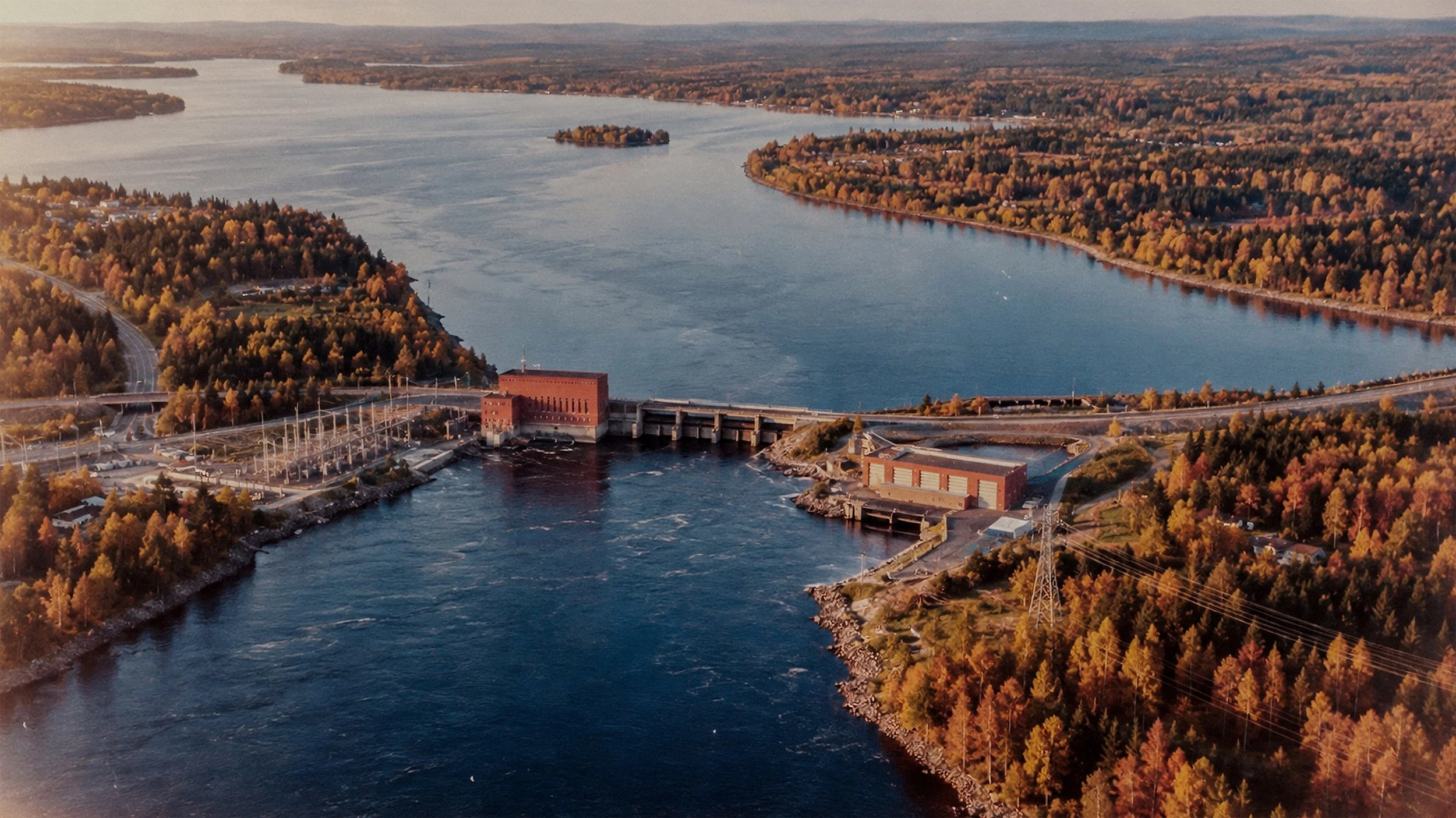
The weather forecast had given us something unusually precise: between ten in the morning and noon, the rain should stop.
That was enough.
My father had recently retired, and as a retirement gift I had given him a fly-fishing outfit of his own. I had also filled a fly box for him with patterns tied at my desk, the kind of gift that carries a small expectation with it. At some point, the rod has to leave its tube and the flies have to meet water.
So we drove to the Kemijoki.
The rain had already passed through when we arrived downstream of Isohaara. The clouds were beginning to open, and every now and then sunlight found a way between them and moved across the river. A north wind came with it, making the air feel colder than the temperature suggested.
Below us was the final stretch of a river with a complicated history.
Isohaara was the first hydropower plant built on the Kemijoki, completed near the river mouth in 1948. Its dam cut the migration route of salmon and other migratory fish into the river system, beginning the transformation of a once free-flowing river into one shaped heavily by hydropower. The history is difficult to ignore when you stand below the dam and look at the Kemijoki moving toward the Bothnian Bay. Yet the river still moves with enormous physical presence. On that morning, it looked particularly alive.
The water level was almost exactly where I wanted it. It was high enough that trout could hold close to the bank instead of retreating farther into the main current, while the water itself had enough warmth to keep fish active.
We could see that activity almost immediately.
Fish were showing on the surface. Some rose quietly, leaving circles that widened and disappeared into the moving water. Others broke clear of it. There were trout among them, and perhaps salmon too. From the bank, it was impossible to know every time a body appeared and vanished, but there was enough movement to keep pulling our eyes away from the casting lesson.
For someone trying to teach fly casting, it was almost too much information.
Learning the Cast
We started with the basics.
Fly casting feels strange when you first hold a rod because so much of what people instinctively want to do is unnecessary. There is no heavy lure pulling the line through the air. The line itself carries the energy, and the rod has to be allowed to load and release it.
I showed my father how to move the rod, how to keep the motion controlled and how to let the line straighten rather than trying to force it forward with strength. The timing takes a while to understand because it is something you feel before you can properly explain it.
At first the line did what fly lines often do in the hands of a beginner. It collapsed, caught itself and landed in places that had not been part of the plan.
Then it started to improve.
A little more line stayed in the air. The loops became cleaner. The leader began landing farther away.
While my father practised from the bank, I kept looking toward the upper part of the rapid, the head of the fast water where the river gathered itself before accelerating downstream.
There was a large rock out there, close to the current.
Near it, we had seen a good fish show itself.
Maybe a trout. Maybe a salmon.
Eventually curiosity won.
I left my father casting and began wading toward the rock.
At the Head of the Rapid
The current changed as I moved farther from shore. Around my legs, the Kemijoki had more weight than it appeared to have from the bank, pushing steadily while I worked my way into position.
I climbed onto the rock and looked upstream.
This was the water I wanted.
At the head of a rapid, the current has not yet become completely chaotic. Faster water begins to gather around slower seams, and those transitions can give a trout exactly what it needs: protection from the strongest current and a steady delivery of food passing nearby.
I began casting.
Every now and then I looked back toward shore.
My father was still working with the rod, and I could already see progress. The cast was beginning to look less like a sequence of instructions and more like one connected movement. The line was travelling farther. He was starting to understand what the rod wanted from him.
Then I turned back to the river.
For my own fishing, I had tied on one of the streamers I trust most, a size 4 pattern built around black and gold with a small red hotspot.
There is nothing particularly complicated about it.
That is true of most of my fly tying. My philosophy is usually that less is more. I would rather give a fly a few things that matter than cover a hook with materials simply because I can. Pike flies are the exception. With those, restraint tends to disappear somewhere beneath a pile of feathers, flash and synthetic fibre.
For trout streamers, I prefer simplicity.
Black gives the fly a strong shape in the water. Gold gives it a little life. The red hotspot adds just enough contrast.
More importantly, I know this pattern works.
I sent it across the current and began fishing the head of the rapid.
The strike came hard.
There was no uncertainty in it, no soft touch that left me wondering whether the fly had brushed a rock. The line came tight and the rod loaded against something alive.
The fish immediately used the current.
For a few moments, all the quiet calculations that come before a take disappeared. There was only pressure through the rod and a fish moving somewhere beneath the broken surface.
Then it turned sideways.
I saw silver.
A second later, I saw the broad pink band along its flank.
Rainbow trout.
I knew it immediately.
I had never caught one before.
From the Rock to the River
My father had stopped casting.
He was standing on the riverbank now with his phone in his hand, filming.
The fish kept working against the rod, using both its own strength and the power of the Kemijoki. From the top of the rock I could control part of the fight, but landing it from there was going to be difficult. The water around me was moving too quickly, and the angle between the fish, the rock and the net was wrong.
Eventually there was only one sensible choice.
I stepped off the rock and back into the current.
The water pressed against my legs as soon as my boots found the riverbed. I kept tension on the fish with one hand and worked myself into a position where I could bring it close enough for the net.
My father kept filming from shore.
The trout made another run.
I let it go, recovered line and slowly brought it back.
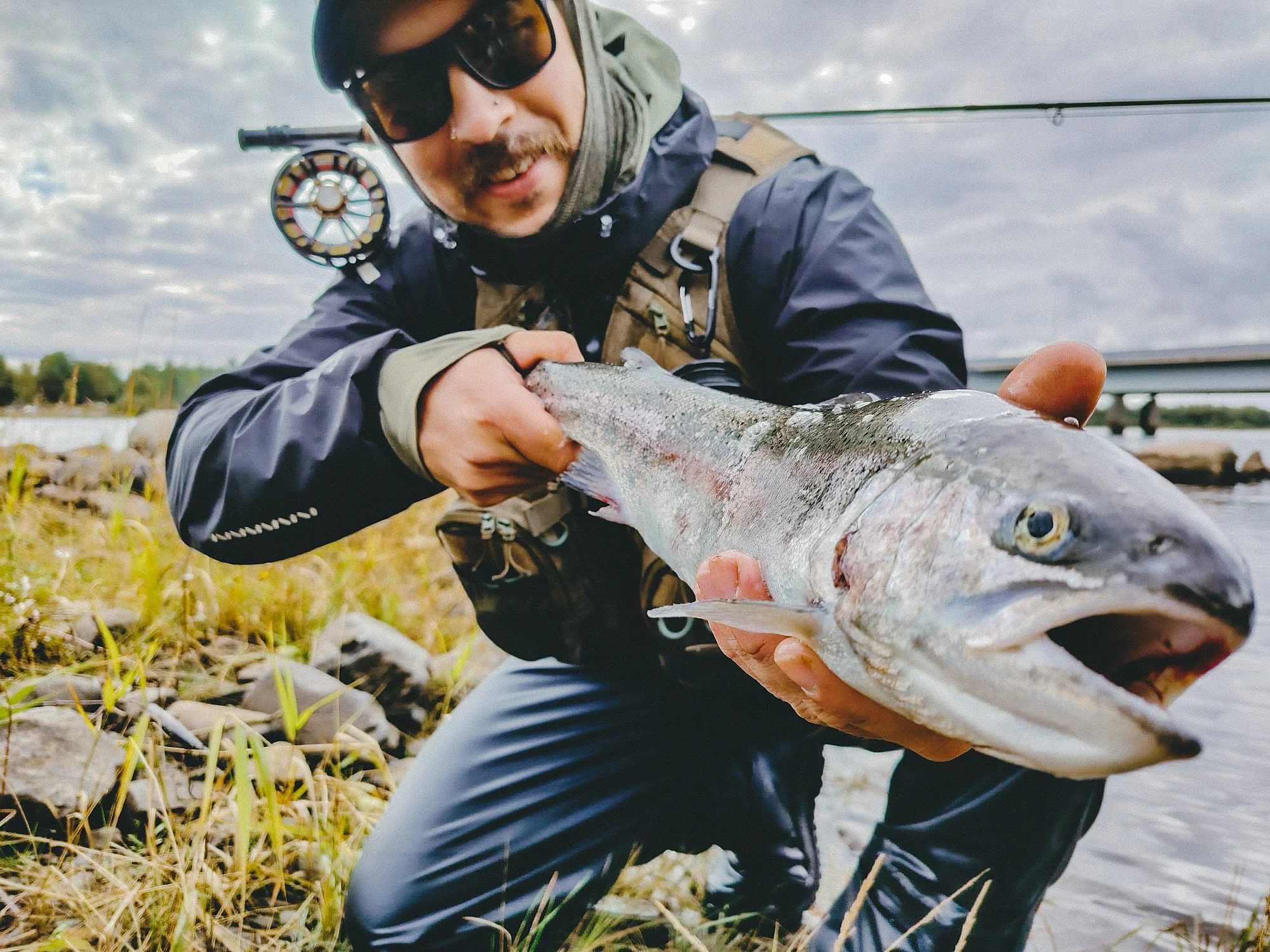
Silver appeared below the surface, then pink, then the dark line of its back. I lowered the net into the current and guided the fish toward it.
This time it came over the rim.
For a few seconds I simply looked down.
My first rainbow trout.
Forty-seven centimetres, 18.5 inches, thick through the body and still carrying the force of the river in its movements. Silver dominated the fish at first glance, but along its side ran the colour that had given it away during the fight, a band of pink against the metallic flank.
In the corner of its mouth sat the fly I had tied myself.
Black. Gold. A little red.
Exactly enough.
The Fish We Kept
I normally release the fish I catch.
This one was different.
When I examined the rainbow more closely, I saw that its other side had been badly damaged by a pike. The injury was serious enough that releasing the fish did not make sense to me.
So we kept it.
The next day, we cooked it.
There is a different feeling to eating a fish you have caught yourself, particularly when you remember almost every part of how it came to hand. I could picture the rock, the head of the rapid and the instant the trout turned sideways beneath the surface. I could see my father standing on the bank with his phone held up, recording a fight neither of us had expected when we drove to the river that morning.
We had come there for casting practice.
That was the plan.
The forecast had given us two hours without rain, and we had used them. My father had made real progress with the fly rod. By the end of the session, his line was travelling with more purpose than when we started, and the strange mechanics of fly casting were already beginning to settle into something more natural.
The fishing could easily have remained secondary.
Instead, somewhere at the head of the rapid below Isohaara, a rainbow trout found a simple black-and-gold streamer with a small red hotspot and decided to change the morning.
After the fish was in the net, we did not continue fishing.
We packed up and left the Kemijoki.
The rain could come back whenever it wanted.
Not a bad day to teach fly casting.
